



How All-City Soccer NYC Integrates Social Emotional Learning into Every Session






All-City Soccer NYC: Where SEL Meets Soccer Training
At All-City Soccer NYC, Social Emotional Learning (SEL) isn’t an add-on—it’s the backbone of everything we do. Our curriculum-based, fun-forward approach integrates SEL into youth soccer at every level, transforming practices and games into powerful classrooms for character development.
We are not just training young athletes; we’re shaping stronger students, teammates, and community members through intentional SEL-focused soccer programming.
What is Social Emotional Learning (SEL)?
Social Emotional Learning (SEL) is the process through which children and adults develop essential life skills: managing emotions, setting goals, showing empathy, building positive relationships, and making responsible choices.
SEL isn’t printed on jerseys or tracked on scoreboards, but it’s the quiet force behind the most meaningful moments in youth sports. When coaches treat sport as a classroom for Social Emotional Learning, they’re not just training athletes; they’re shaping community leaders.
Our SEL-Integrated Practice Structure
-
Emotional Check-Ins: Building Self-Awareness from Day One
Every All-City Soccer session begins with an emotional check-in, not with laps. Players arrive carrying the day with them: a bad grade, a family argument, the stress of New York City life. Our coaches start practice by asking: “On a scale of 1 to 5, how are you feeling today—and why?”
This simple routine builds self-awareness in youth sports. Players pause and notice: “I’m at a 2 because I’m still mad about a test,” or “I’m at a 4 because I’m excited for our game.” By naming emotions, they start to separate what they feel from how they behave on the field.
SEL Skill Developed: Self-awareness
-
Drills with Purpose: Practicing Self-Management in Real Time
At All-City Soccer NYC, drills and small-sided games come with a SEL twist. Any time a player reacts by yelling at a teammate or acting disrespectfully, the play stops. Our coaches ask: “What just happened? And “How else could we have responded?”
This is self-management in practice—learning to regulate impulses in the moment. Players learn to pause, breathe, and choose their response rather than simply reacting to frustration.
SEL Skills Developed: Self-management, emotional regulation, impulse control
-
Player-Led Conflict Resolution: Developing Social Awareness
When conflicts arise during All-City Soccer sessions—a disputed foul, a disagreement over possession—our coaches don’t immediately step in. Instead, they invite players to solve it: “Both of you explain what you saw; then as a group, decide what’s fair.”
This approach practices social awareness (seeing from another person’s perspective) and relationship skills (listening, negotiating, and finding common ground). Players learn that different perspectives can coexist and that respectful disagreement strengthens the team.
SEL Skills Developed: Social awareness, relationship skills, active listening, perspective-taking
-
Reflection Circles: Connecting Growth to Identity
By the end of every All-City Soccer practice, coaches gather the team for reflection: “What did you learn about yourself today, not just as a player, but as a person?”
One player might share that he stayed calmer after a mistake than last week. Another says she spoke up more instead of withdrawing. These are SEL gains, not just technical improvements—and our curriculum is designed to celebrate both equally.
SEL Skills Developed: Self-reflection, growth mindset, self-awareness
The Five Core SEL Competencies in Our Curriculum
Our intentional SEL programming addresses all five core CASEL competencies:
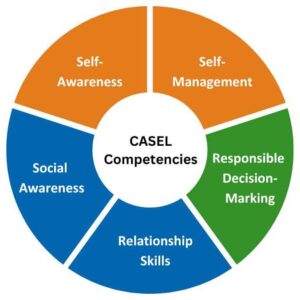
How All-City Soccer Develops Leaders with Strong SEL Skills
Building Captains with SEL Competencies
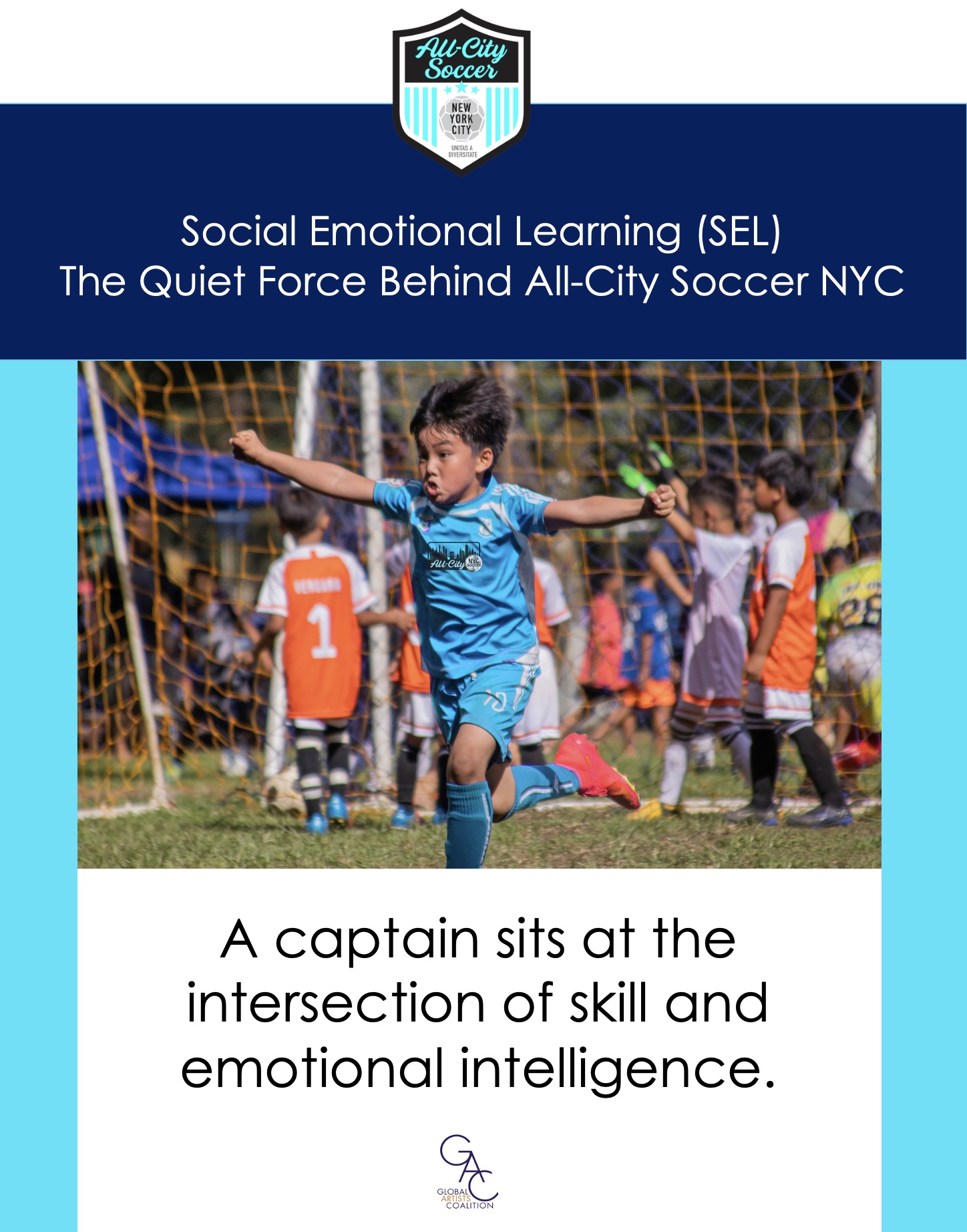
Social Emotional Learning sits at the heart of what it means to be a captain in All-City Soccer programs—not just someone who wears the armband. Our youth soccer leadership training focuses on developing captains who:
Understand their own emotions and provide emotional steadiness that teammates mirror. Captains with strong SEL skills become the emotional thermostat of the team: they don’t just measure the temperature; they help set it.
Notice who needs support—who is frustrated, checked out, or needs encouragement rather than criticism. Captains with strong social awareness listen actively, ask questions, and know when to pull someone aside quietly instead of calling them out publicly.
Communicate to build trust. Those relationship skills—listening, communicating clearly, showing empathy—mean that when a captain says, “Let’s adjust our shape and press together,” players follow not just because of tactics, but because they feel respected and understood.
Make responsible decisions under pressure—how to talk to referees, when to push tempo, how to respond when opponents play dirty. SEL helps them pause, quickly weigh options, and choose actions that support the team’s values and long-term goals, not just their own frustration in the moment.
SEL Skills Developed: Self-awareness, social awareness, relationship skills, responsible decision-making, leadership
Teaching Healthy Responses to Winning and Losing
At All-City Soccer NYC, we teach players that SEL is key to responding well to wins. After a big victory, a player with strong SEL skills can feel proud and excited without becoming arrogant or disrespectful. They celebrate while staying grounded, understanding that one game doesn’t define their worth. Wins are data and feedback, not the whole story.
SEL Skills Developed: Humility, perspective, emotional regulation
Building Resilience Through Losses
Our SEL curriculum helps players respond to losing in constructive ways. Instead of shutting down, blaming others, or saying, “we’re terrible,” All-City Soccer players learn to sit with disappointment and stay curious: What did we learn? What can we try differently next time?
They still show up as good teammates—high-fiving others, thanking coaches, and staying respectful in the handshake line. Losing can be an opportunity to practice resilience, self-reflection, and empathy, both for themselves and for teammates who may be taking it even harder.
Winning and losing become moments for growth, not identity. The scoreboard still matters, but it shares the stage with character: how players handle joy, disappointment, and everything in between. That’s where SEL, leadership, and performance all intersect.
SEL Skills Developed: Resilience, growth mindset, empathy, sportsmanship, emotional intelligence
Why All-City Soccer’s Intentional Approach Works
We don’t leave SEL development to chance. While sports naturally create SEL moments—missed shots, tough referee calls, substitutions, high-pressure games—our curriculum ensures these moments become learning opportunities.
Practice and games are not just drills and tactics at All-City Soccer NYC—they are laboratories where SEL skills grow because coaches are intentional about:
- Stopping play to address emotional reactions
- Asking reflection questions that build self-awareness
- Creating team circles for discussion and problem-solving
- Modeling SEL skills in their own coaching behavior
- Celebrating character growth alongside technical improvement
Studies and field experience show that when SEL is built into practice design—through reflection questions, team circles, and intentional debriefs—players become more resilient, empathetic, and confident. Athletes who learn SEL competencies handle pressure better, bounce back from setbacks, and are more likely to be positive leaders in other settings.
From the Soccer Field to Life: Transferring SEL Skills
The true test of All-City Soccer’s SEL curriculum is what happens when the game ends. Our players transfer these skills into everyday life:
- A middle school player who learns to breathe and reset after missing a penalty practices the same skill before a big exam
- A team that learns to disagree respectfully in a huddle rehearses how to navigate conflict in classrooms, friendships, and families
- A captain who learns to read teammates’ emotions becomes more attuned to siblings, classmates, and friends
Evidence from youth sports research shows that when environments are supportive and SEL-focused like All-City Soccer, kids are more likely to:
- Stay engaged in sport
- Feel a sense of belonging
- Handle pressure better
- Bounce back from setbacks
- Become positive leaders in other settings
- Transfer skills into school, family, and community life
They don’t just become better competitors; they become more thoughtful classmates, caring siblings, and active community members.
All-City Soccer NYC: Every Session is an SEL Opportunity
When coaches prioritize Social Emotional Learning, they turn sports into powerful spaces for personal growth and character development. Our SEL-integrated soccer curriculum proves that youth sports can be the best classroom for life skills.
We’re not just building soccer players—we’re developing the next generation of emotionally intelligent, empathetic, and resilient community leaders. At All-City Soccer NYC, Social Emotional Learning guides everything we do, helping young athletes develop the skills they need to succeed on the field, in school, and in life. Become an All-City Soccer Club member.